Digital transformation has become a necessity for businesses that want to stay competitive in today’s technology-driven world. Organizations of all sizes are adopting innovative tools to improve efficiency, enhance customer experiences, and make smarter decisions. Among the technologies driving this change, artificial intelligence (AI) stands out as one of the most influential.
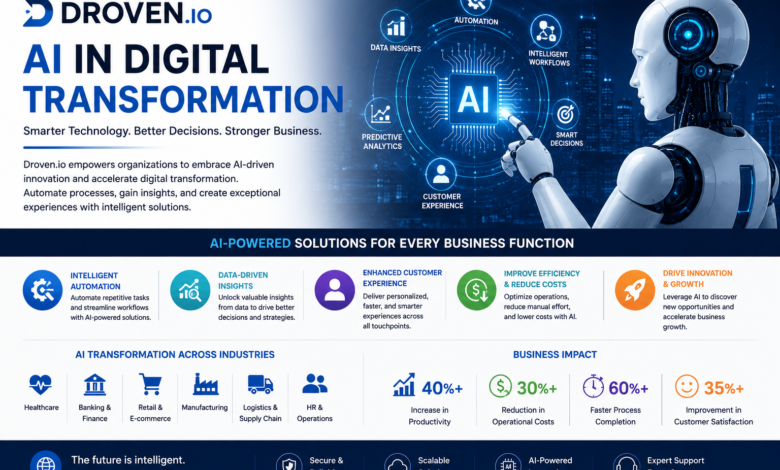
The growing interest in Droven.io AI in Digital Transformation reflects how businesses are exploring AI-powered solutions to streamline operations, automate repetitive tasks, and unlock valuable insights from data. Rather than simply replacing manual work, AI enables organizations to work smarter, respond faster to market changes, and create new opportunities for growth.
This article explains the role of AI in digital transformation, its benefits, common applications, implementation strategies, challenges, and future trends.
What Is Digital Transformation?
Digital transformation is the process of integrating digital technologies into every aspect of a business. It changes how organizations operate, deliver products or services, and interact with customers.
Instead of relying on traditional methods, businesses use modern technologies such as cloud computing, artificial intelligence, data analytics, automation, and the Internet of Things (IoT) to improve performance and remain competitive.
Digital transformation is not only about adopting new software. It also involves improving business processes, encouraging innovation, and building a culture that embraces continuous improvement.
Understanding Artificial Intelligence in Business
Artificial intelligence refers to computer systems that can perform tasks requiring human intelligence. These tasks include learning from data, recognizing patterns, making predictions, understanding language, and supporting decision-making.
Businesses use AI to automate routine activities, analyze large amounts of information, improve customer service, and optimize workflows. AI-powered systems help employees focus on creative and strategic work while reducing repetitive manual tasks.
Understanding Droven.io AI in Digital Transformation
The concept of Droven.io AI in Digital Transformation focuses on using artificial intelligence to modernize business operations and improve efficiency. AI-driven technologies can support organizations by simplifying workflows, analyzing business data, and helping teams make informed decisions more quickly.
As companies continue their digital transformation journeys, AI has become an essential technology for improving productivity and delivering better customer experiences.
Why AI Matters in Digital Transformation
Artificial intelligence offers significant advantages for organizations undergoing digital transformation.
Faster Decision-Making
AI can analyze large volumes of business data within seconds, providing insights that support informed decision-making.
Increased Productivity
Routine administrative tasks can be automated, allowing employees to concentrate on higher-value responsibilities.
Improved Customer Experience
AI-powered chatbots and virtual assistants provide quick responses to customer questions, improving satisfaction and reducing response times.
Better Accuracy
Automation reduces manual errors in data entry, reporting, and document processing.
Cost Optimization
By automating repetitive processes, businesses can reduce operational costs and improve resource utilization.
Key Features of AI-Driven Digital Transformation
Organizations exploring AI solutions often look for features that improve efficiency and scalability.
Intelligent Automation
AI automates repetitive business processes while adapting to changing conditions.
Predictive Analytics
Businesses use AI to forecast customer behavior, market trends, and operational performance.
Natural Language Processing
AI systems can understand and process human language, making customer support and document analysis more efficient.
Machine Learning
Machine learning enables systems to improve performance over time by learning from historical data.
Workflow Optimization
AI identifies bottlenecks and recommends process improvements that increase efficiency.
Business Benefits of AI Integration
Businesses implementing AI as part of their digital transformation strategy often experience measurable improvements.
- Faster business operations
- Improved customer satisfaction
- Better resource management
- Enhanced data accuracy
- Reduced operational costs
- Increased employee productivity
- Smarter business planning
- Better risk management
These benefits help organizations remain competitive in rapidly changing markets.
Industries Using AI for Digital Transformation
Artificial intelligence is transforming a wide range of industries.
Healthcare
Hospitals and clinics use AI to assist with diagnostics, appointment scheduling, patient record management, and administrative tasks.
Financial Services
Banks use AI to detect fraud, assess risks, automate compliance checks, and improve customer support.
Retail
Retail businesses apply AI to personalize recommendations, manage inventory, predict demand, and optimize pricing strategies.
Manufacturing
Manufacturers use AI for predictive maintenance, quality control, supply chain optimization, and production planning.
Education
Educational institutions use AI to personalize learning experiences, automate administrative processes, and analyze student performance.
Common AI Applications in Business
Organizations implement AI in many everyday business activities, including:
- Customer service chatbots
- Email automation
- Sales forecasting
- Document processing
- Invoice management
- Marketing personalization
- Inventory optimization
- HR recruitment support
- Data analytics
- Cybersecurity monitoring
These applications improve efficiency while supporting long-term business growth.
How Businesses Can Successfully Implement AI
Implementing artificial intelligence requires careful planning and a clear strategy. Businesses should focus on solving real operational challenges instead of adopting AI simply because it is a popular technology.
Identify Business Goals
The first step is understanding what the business wants to achieve. Whether the objective is reducing costs, improving customer service, increasing productivity, or making better decisions, clear goals help guide the implementation process.
Assess Existing Processes
Review current workflows to identify repetitive tasks and areas where AI can add value. Processes involving large amounts of data or routine decision-making are often good candidates for automation.
Choose the Right AI Solutions
Different AI tools serve different purposes. Businesses should select solutions that align with their operational needs, technical capabilities, and long-term growth plans.
Prepare High-Quality Data
Artificial intelligence performs best when it has access to accurate and well-organized data. Cleaning and managing business data is an important step before deploying AI-powered systems.
Train Employees
Successful digital transformation depends on people as much as technology. Employees should understand how AI supports their work and receive training on new tools and workflows.
Monitor and Improve
AI implementation is an ongoing process. Businesses should regularly measure performance, gather feedback, and refine their AI strategies to achieve better results over time.
Challenges of AI in Digital Transformation
While AI offers many advantages, organizations may face challenges during implementation.
High Initial Investment
Introducing AI solutions may require investments in software, infrastructure, and employee training. However, many organizations recover these costs through increased efficiency and long-term savings.
Data Privacy and Security
AI systems often process sensitive business and customer information. Companies must protect this data by following security best practices and complying with relevant regulations.
Integration with Existing Systems
Many organizations still rely on legacy software. Integrating AI with older systems can require additional planning and technical expertise.
Employee Adoption
Some employees may be concerned that automation could replace their roles. Clear communication and proper training can help teams understand that AI is designed to assist rather than replace human expertise.
Maintaining AI Systems
AI models should be monitored and updated regularly to ensure they continue delivering accurate and reliable results as business conditions change.
Best Practices for AI-Driven Digital Transformation
Organizations can maximize the benefits of AI by following these best practices:
- Start with small pilot projects before expanding AI across the business.
- Focus on solving real business problems rather than adopting technology for its own sake.
- Maintain high-quality and secure data.
- Measure performance using clear business metrics.
- Encourage collaboration between business teams and IT professionals.
- Continuously review and improve AI-powered processes.
- Keep employees involved throughout the transformation journey.
These practices help reduce risks while increasing the likelihood of successful AI adoption.
The Future of AI in Digital Transformation
Artificial intelligence continues to evolve, opening new possibilities for businesses around the world. Future developments are expected to make AI even more capable, accessible, and valuable.
Emerging trends include:
- Smarter business automation
- Predictive decision-making
- AI-powered customer experiences
- Advanced data analytics
- Intelligent document processing
- Personalized digital services
- Autonomous business workflows
- Greater integration with cloud platforms
As these technologies mature, organizations that embrace innovation will be better prepared to adapt to changing market demands and customer expectations.
Why Businesses Are Investing in AI
Companies invest in AI because it provides measurable business value. From improving operational efficiency to delivering personalized customer experiences, AI helps organizations remain competitive in an increasingly digital economy.
Businesses that successfully combine AI with digital transformation strategies can:
- Increase productivity
- Improve decision-making
- Reduce operational costs
- Deliver faster services
- Strengthen customer relationships
- Support innovation
- Build scalable operations
- Create sustainable long-term growth
These advantages make AI one of the most important technologies shaping the future of business.
Conclusion
The growing interest in Droven.io AI in Digital Transformation highlights the increasing importance of artificial intelligence in modern business. AI enables organizations to automate repetitive tasks, analyze data more effectively, improve customer experiences, and support informed decision-making.
Digital transformation is not simply about adopting new technologies—it is about creating smarter, more efficient ways of working. By implementing AI thoughtfully, investing in employee training, and continuously improving business processes, organizations can unlock new opportunities for innovation and growth.
As artificial intelligence continues to advance, businesses that embrace AI-driven digital transformation will be well positioned to improve efficiency, remain competitive, and succeed in an ever-changing digital landscape.
Frequently Asked Questions (FAQs)
What is Droven.io AI in Digital Transformation?
It refers to the use of artificial intelligence to improve business processes, automate workflows, analyze data, and support digital transformation initiatives.
How does AI support digital transformation?
AI automates repetitive tasks, provides data-driven insights, enhances customer experiences, and improves operational efficiency across different business functions.
Which industries benefit from AI?
Healthcare, finance, retail, manufacturing, education, logistics, and many other industries use AI to improve productivity and decision-making.
Is AI only suitable for large businesses?
No. Small and medium-sized businesses can also adopt AI solutions to automate routine tasks, improve customer service, and increase operational efficiency.
What is the biggest advantage of AI in business?
One of the greatest advantages is its ability to process large amounts of data quickly, helping organizations make faster and more informed decisions while reducing manual effort.