Businesses today face increasing pressure to work faster, reduce costs, and deliver better customer experiences. Manual processes often slow operations, create errors, and consume valuable employee time. This is where automation technologies have become essential.
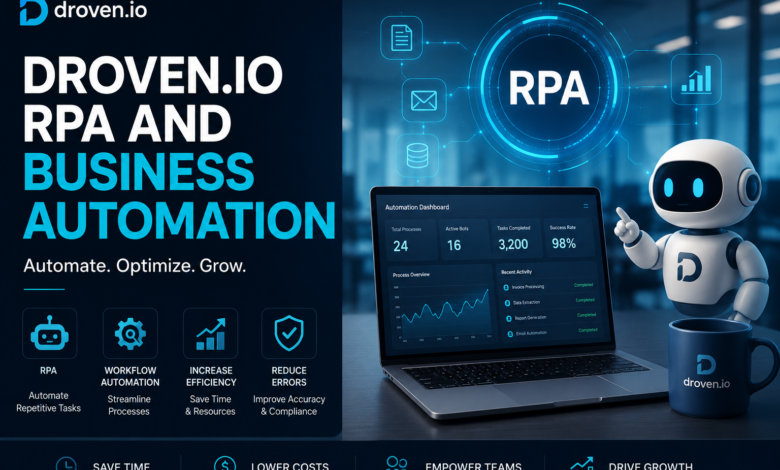
One of the growing topics in digital transformation is Droven.io RPA and Business Automation. Organizations across industries are exploring automation platforms that simplify repetitive work while allowing employees to focus on strategic and creative tasks.
In this guide, we will explore what Droven.io RPA and Business Automation means, how robotic process automation (RPA) works, its key benefits, common use cases, implementation strategies, challenges, and future trends.
Understanding Robotic Process Automation (RPA)
Robotic Process Automation, commonly known as RPA, is software technology that automates repetitive digital tasks. Instead of replacing people, software bots perform routine activities that normally require human interaction.
These automated bots can:
- Copy and paste data
- Read emails
- Fill online forms
- Generate reports
- Move files
- Process invoices
- Update databases
- Extract information from documents
Unlike traditional automation that often requires major software changes, RPA works with existing business applications, making implementation faster and more cost-effective.
What is Business Automation?
Business automation goes beyond simple task automation. It combines technology, workflows, business rules, and sometimes artificial intelligence to automate complete business processes.
Examples include:
- Employee onboarding
- Customer support workflows
- Sales lead management
- Financial reporting
- Inventory management
- HR operations
- Compliance monitoring
Business automation helps organizations operate with greater speed, consistency, and accuracy.
Understanding Droven.io RPA and Business Automation
The term Droven.io RPA and Business Automation refers to using automation technologies to optimize everyday business operations through intelligent workflow management and robotic process automation.
Instead of relying on employees to perform repetitive administrative work, automated workflows handle routine operations while employees focus on higher-value responsibilities.
Businesses adopting automation often aim to improve operational efficiency without increasing workforce costs.
Why Businesses Need Automation
Modern companies generate enormous amounts of data every day. Processing this information manually can become expensive and time-consuming.
Automation helps organizations solve several common problems:
Reduces Manual Work
Employees no longer spend hours entering the same information into multiple systems.
Improves Accuracy
Automated workflows perform tasks consistently, reducing human errors.
Saves Time
Processes that once required several hours can often be completed within minutes.
Increases Productivity
Teams can dedicate more time to innovation, customer relationships, and business growth.
Enhances Customer Experience
Faster service means customers receive quicker responses and improved support.
Key Features of Droven.io RPA and Business Automation
Businesses evaluating automation solutions often look for features that support long-term growth.
Important capabilities include:
Workflow Automation
Business processes can be organized into automated workflows that reduce delays and eliminate repetitive approvals.
Data Processing
Automation tools collect, validate, and organize information from multiple sources.
Integration
Modern automation platforms connect with CRM systems, ERP software, cloud services, accounting applications, and communication tools.
Reporting
Automated reporting provides managers with real-time visibility into business performance.
Scheduling
Routine tasks can run automatically based on predefined schedules without human intervention.
Notifications
Users receive alerts whenever important actions require attention.
Benefits of Droven.io RPA and Business Automation
Organizations implementing automation often experience improvements across multiple departments.
Cost Savings
Reducing repetitive manual work lowers operational expenses over time.
Higher Productivity
Employees spend less time on routine administrative tasks.
Better Compliance
Automation follows predefined business rules, helping organizations maintain compliance.
Improved Data Quality
Automated validation reduces duplicate records and incorrect information.
Faster Decision Making
Managers receive reports more quickly, allowing them to make informed business decisions.
Business Scalability
Automation enables companies to manage increasing workloads without proportional increases in staffing.
Industries That Benefit from Automation
Automation is useful across nearly every industry.
Healthcare
Healthcare providers automate patient registration, appointment scheduling, billing, and record management.
Banking and Finance
Financial institutions automate loan processing, compliance checks, fraud detection, and transaction monitoring.
Retail
Retail businesses automate inventory tracking, order management, customer support, and pricing updates.
Manufacturing
Manufacturers automate production reporting, supply chain management, quality control, and maintenance scheduling.
Human Resources
HR teams automate recruitment workflows, onboarding, attendance management, payroll support, and document processing.
Education
Educational institutions automate admissions, student records, fee collection, and communication.
Common Business Processes Suitable for Automation
Many repetitive tasks are ideal candidates for automation.
Examples include:
- Invoice processing
- Purchase order approvals
- Customer onboarding
- Employee onboarding
- Payroll processing
- Expense management
- Email routing
- Report generation
- Inventory updates
- CRM data entry
- Lead assignment
- Help desk ticket creation
These processes often consume significant employee time but require limited human judgment.
How Businesses Can Implement Automation Successfully
Successful automation requires careful planning rather than automating everything at once.
Identify Repetitive Tasks
Begin by finding processes that employees perform repeatedly every day.
Set Clear Goals
Define measurable objectives such as reducing processing time or improving accuracy.
Map Existing Workflows
Understand each step before designing automated processes.
Start Small
Pilot projects allow organizations to evaluate performance before expanding automation.
Monitor Performance
Track key metrics to identify opportunities for continuous improvement.
Train Employees
Employees should understand how automation supports their work rather than replacing their roles.
Challenges of Business Automation
Although automation offers many advantages, organizations should prepare for potential challenges.
Initial Investment
Implementing automation may require software, training, and integration costs.
Process Complexity
Poorly designed workflows can limit automation effectiveness.
Employee Resistance
Some employees may worry about changes to their daily responsibilities.
Integration Issues
Connecting legacy systems with modern automation tools may require additional planning.
Ongoing Maintenance
Automated workflows should be reviewed regularly to remain effective as business processes evolve.
Best Practices for Successful Automation
Businesses can maximize results by following proven practices.
- Focus on high-volume repetitive work.
- Keep workflows simple during initial implementation.
- Measure performance regularly.
- Review automated processes periodically.
- Maintain data quality.
- Ensure proper security controls.
- Encourage collaboration between business and IT teams.
The Future of RPA and Business Automation
Automation continues to evolve alongside artificial intelligence and machine learning.
Future automation solutions are expected to provide:
- Smarter document understanding
- Predictive analytics
- Intelligent decision support
- Natural language interactions
- Advanced workflow optimization
- Improved customer personalization
- Greater cloud integration
- Enhanced security features
As organizations continue their digital transformation journeys, automation will play an increasingly important role in improving efficiency and competitiveness.
Is Droven.io RPA and Business Automation Worth Exploring?
Businesses seeking greater operational efficiency are increasingly adopting automation technologies to reduce repetitive work and improve productivity. Whether managing customer service, finance, HR, or supply chain operations, automation can help streamline processes and support business growth.
By carefully planning automation initiatives, selecting suitable workflows, and continuously monitoring performance, organizations can build more efficient operations while allowing employees to focus on innovation, collaboration, and customer value.
Conclusion
Droven.io RPA and Business Automation represents the growing importance of intelligent workflow automation in today’s business environment. Organizations are looking for practical ways to reduce manual work, improve operational accuracy, and deliver faster services without sacrificing quality.
When implemented thoughtfully, robotic process automation and business automation can simplify repetitive processes, lower operational costs, enhance compliance, and create better experiences for both employees and customers. As automation technologies continue to advance, businesses that embrace digital transformation will be better positioned to adapt, compete, and grow in an increasingly technology-driven marketplace.