Artificial Intelligence (AI) is transforming industries across the globe, and Sweden is no exception. From manufacturing and healthcare to finance and retail, organizations are increasingly adopting AI-powered solutions to improve efficiency, enhance customer experiences, and gain competitive advantages. However, implementing AI successfully requires more than simply investing in new technology. Businesses need a clear strategy, expert guidance, and a long-term vision to unlock the full value of artificial intelligence.
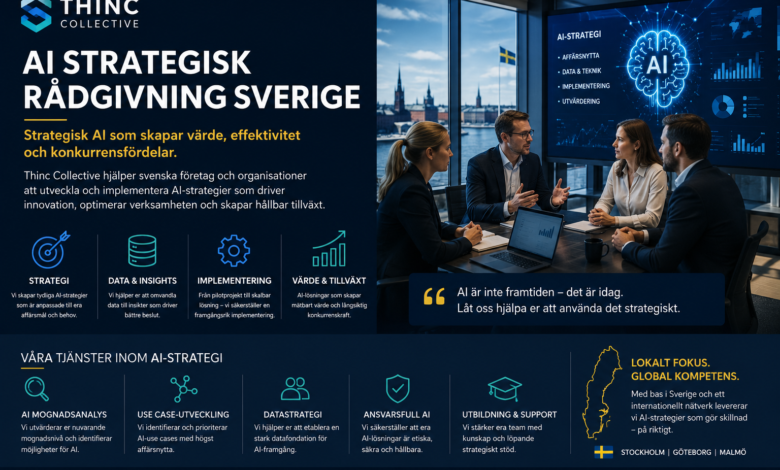
This is where Thinc Collective AI Strategisk Rådgivning Sverige becomes relevant. Strategic AI consulting helps organizations understand how artificial intelligence can support business goals, optimize operations, and create new opportunities for innovation. As Swedish companies continue their digital transformation journeys, AI strategy has become a critical component of sustainable growth.
This article explores the role of AI strategic consulting in Sweden, the benefits of AI adoption, and how organizations can leverage intelligent technologies to achieve long-term success.
Understanding AI Strategic Consulting
AI strategic consulting involves helping businesses identify, plan, and implement artificial intelligence solutions that align with organizational objectives.
Rather than focusing solely on technology, strategic AI consulting examines:
- Business goals
- Operational challenges
- Data infrastructure
- Customer needs
- Market opportunities
- Long-term growth strategies
The objective is to ensure that AI investments generate measurable value while minimizing risks and implementation challenges.
Organizations often face questions such as:
- Which AI solutions are most suitable?
- How should AI be integrated into existing systems?
- What data is required?
- How can return on investment be measured?
- What skills and resources are needed?
Strategic AI advisors help answer these questions through structured planning and expert guidance.
Why Sweden Is Embracing Artificial Intelligence
Sweden has established itself as one of Europe’s most innovative economies. The country’s strong technology ecosystem, digital infrastructure, and commitment to innovation create an ideal environment for AI adoption.
Several factors contribute to Sweden’s growing interest in AI:
Advanced Digital Infrastructure
Swedish businesses benefit from widespread internet access, cloud computing adoption, and modern digital systems.
Innovation-Driven Economy
Innovation remains a key driver of economic growth across Sweden’s public and private sectors.
Strong Technology Talent
The country produces highly skilled professionals in software development, engineering, data science, and artificial intelligence.
Government Support
Digital transformation initiatives continue encouraging businesses to embrace advanced technologies.
These factors make Sweden an attractive market for AI-driven business transformation.
The Importance of AI Strategy
Many organizations recognize the potential of AI but struggle to implement it effectively.
Without a clear strategy, businesses may face:
- Unsuccessful projects
- Poor data quality
- High implementation costs
- Limited adoption
- Low return on investment
Strategic planning helps organizations avoid these challenges.
An effective AI strategy typically includes:
Business Objective Alignment
AI initiatives should directly support organizational goals.
Data Readiness Assessment
High-quality data is essential for successful AI implementation.
Technology Selection
Choosing the right tools and platforms is critical.
Workforce Preparation
Employees must understand how AI will impact workflows and decision-making.
Performance Measurement
Organizations need clear metrics to evaluate results.
A structured approach increases the likelihood of long-term success.
Key Areas Where AI Creates Value
Artificial intelligence can generate value across multiple business functions.
Customer Experience
AI helps organizations improve customer interactions through:
- Personalized recommendations
- Intelligent chatbots
- Customer analytics
- Automated support systems
Enhanced customer experiences often lead to stronger loyalty and increased revenue.
Operational Efficiency
Automation reduces repetitive tasks and improves productivity.
Examples include:
- Workflow automation
- Document processing
- Scheduling optimization
- Inventory management
Organizations can save time and resources while improving accuracy.
Data Analytics
AI enables businesses to extract meaningful insights from large datasets.
Benefits include:
- Trend identification
- Predictive analytics
- Market forecasting
- Customer behavior analysis
Better insights support smarter decision-making.
Risk Management
AI can identify potential risks before they become significant problems.
Applications include:
- Fraud detection
- Cybersecurity monitoring
- Compliance management
- Financial risk assessment
This proactive approach improves organizational resilience.
AI Adoption Challenges
Although AI offers substantial benefits, implementation is not always straightforward.
Common challenges include:
Data Quality Issues
Poor-quality data can reduce AI accuracy and effectiveness.
Skills Gaps
Organizations may lack employees with AI expertise.
Change Management
Employees sometimes resist new technologies due to uncertainty or fear of disruption.
Integration Complexity
Combining AI solutions with existing systems can be technically challenging.
Ethical Considerations
Organizations must address issues related to privacy, transparency, and responsible AI use.
Strategic consulting helps businesses navigate these obstacles more effectively.
Building a Successful AI Roadmap
A successful AI initiative begins with a clear roadmap.
Step 1: Assess Current Capabilities
Organizations should evaluate their existing technology infrastructure, data resources, and business processes.
Step 2: Identify Opportunities
Potential AI use cases should be prioritized based on business value and feasibility.
Step 3: Develop a Strategy
A detailed plan outlines objectives, timelines, resources, and expected outcomes.
Step 4: Launch Pilot Projects
Small-scale implementations help validate assumptions before larger investments.
Step 5: Scale Successful Solutions
Organizations can expand proven AI initiatives across departments and business functions.
This phased approach reduces risk and increases implementation success.
AI and Digital Transformation
Artificial intelligence plays a central role in modern digital transformation efforts.
Digital transformation involves using technology to improve business processes, customer experiences, and operational efficiency.
AI contributes by enabling:
- Intelligent automation
- Predictive analytics
- Personalized experiences
- Data-driven decision-making
- Process optimization
Businesses that combine AI with broader digital transformation strategies often achieve stronger results.
Future Trends in AI Consulting
The AI consulting landscape continues evolving rapidly.
Several trends are expected to shape the future:
Generative AI
Generative AI tools are transforming content creation, customer support, and software development.
Industry-Specific Solutions
AI platforms are becoming increasingly specialized for sectors such as healthcare, finance, and manufacturing.
Responsible AI Frameworks
Organizations are placing greater emphasis on ethical AI practices.
Real-Time Analytics
Businesses increasingly require instant insights and decision support.
Human-AI Collaboration
Future workplaces will focus on combining human expertise with AI capabilities.
These developments will create new opportunities for organizations across Sweden and beyond.
Why Strategic AI Guidance Matters
Successful AI implementation requires more than technology alone. Organizations need a clear understanding of business priorities, data requirements, operational challenges, and long-term goals.
Strategic AI consulting provides:
- Expert guidance
- Risk reduction
- Faster implementation
- Improved decision-making
- Greater return on investment
Businesses that approach AI strategically are better positioned to achieve sustainable growth and competitive advantages.
Conclusion
Thinc Collective AI Strategisk Rådgivning Sverige reflects the growing importance of strategic artificial intelligence consulting in today’s digital economy. As Swedish organizations continue adopting advanced technologies, expert guidance becomes essential for maximizing the value of AI investments.
From customer experience improvements and operational efficiency gains to predictive analytics and intelligent automation, artificial intelligence offers tremendous opportunities for innovation and growth. However, success depends on careful planning, strong leadership, and a well-defined strategy.
Organizations that embrace AI strategically can unlock new levels of performance, strengthen competitiveness, and prepare for the future of business in an increasingly technology-driven world.