Artificial intelligence (AI) has become one of the most transformative technologies of the modern era. From automating repetitive tasks to generating valuable business insights, AI is reshaping industries worldwide. Organizations, entrepreneurs, educators, and content creators are increasingly adopting AI-powered tools to improve productivity, streamline workflows, and make better decisions.
One search term gaining attention is Abraham Quiros Villalba AI Tool. As interest in AI technologies grows, users are searching for platforms, tools, and innovations associated with experts and emerging digital solutions. Whether for business automation, content creation, data analysis, or workflow optimization, AI tools continue to evolve rapidly and offer practical benefits across multiple sectors.
This article explores the concept of Abraham Quiros Villalba AI Tool, the role of artificial intelligence in today’s digital economy, the features modern AI platforms typically offer, and how intelligent automation is shaping the future of work.
The Rise of Artificial Intelligence
Artificial intelligence has moved beyond research laboratories and into everyday life. Businesses now rely on AI to improve efficiency, reduce costs, and enhance customer experiences.
Common applications of AI include:
- Content generation
- Customer support
- Data analysis
- Business automation
- Marketing optimization
- Software development
- Predictive analytics
As AI capabilities continue expanding, organizations are discovering new ways to integrate intelligent technologies into their operations.
Understanding the Abraham Quiros Villalba AI Tool
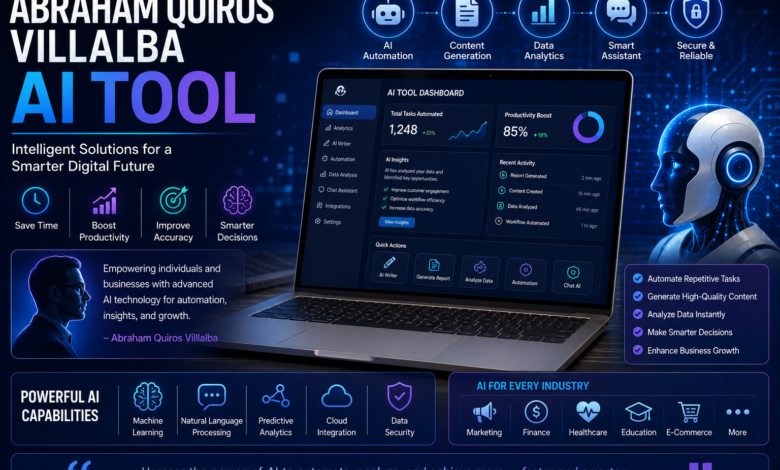
The term Abraham Quiros Villalba AI Tool is commonly associated with interest in AI-powered solutions that help automate digital tasks, improve productivity, and support smarter decision-making.
Although AI tools vary in their purpose and functionality, many are designed to:
- Automate repetitive workflows
- Analyze large datasets
- Generate written content
- Improve operational efficiency
- Assist with business decision-making
- Enhance user experiences
Modern AI solutions are built to reduce manual effort while increasing accuracy and speed.
Why AI Tools Are Becoming Essential
Businesses generate enormous amounts of information every day. Managing this data manually is time-consuming and often inefficient.
AI tools help organizations by:
Saving Time
Automation allows repetitive tasks to be completed in seconds instead of hours.
Increasing Productivity
Employees can focus on strategic work instead of routine administrative tasks.
Improving Accuracy
AI systems reduce human errors and provide more consistent results.
Supporting Better Decisions
Machine learning algorithms identify patterns and trends that may not be immediately visible.
Enhancing Customer Experiences
AI enables personalized services and faster response times.
These advantages make AI a valuable investment for organizations of all sizes.
Key Features of Modern AI Tools
Most AI platforms include several core capabilities that support business operations.
Intelligent Automation
Automation remains one of AI’s greatest strengths.
Typical automated tasks include:
- Email management
- Report generation
- Workflow approvals
- Data entry
- Document processing
Automation improves efficiency while reducing operational costs.
Machine Learning
Machine learning allows systems to improve continuously by analyzing historical data.
Benefits include:
- Better predictions
- Improved recommendations
- Smarter decision-making
- Adaptive learning
Machine learning helps AI become more effective over time.
Natural Language Processing
Natural Language Processing (NLP) enables computers to understand and generate human language.
Applications include:
- AI chatbots
- Virtual assistants
- Content creation
- Translation
- Customer support
NLP significantly improves communication between humans and machines.
Predictive Analytics
AI can analyze historical information to forecast future outcomes.
Businesses use predictive analytics for:
- Sales forecasting
- Inventory management
- Financial planning
- Customer behavior analysis
- Risk assessment
Accurate forecasting supports better strategic planning.
AI Tools for Content Creation
Content creation has become one of the fastest-growing applications of artificial intelligence.
Modern AI writing tools assist with:
- Blog articles
- Product descriptions
- Marketing campaigns
- Email newsletters
- Social media content
- Business documentation
While AI accelerates content production, human editing remains important for maintaining originality, tone, and factual accuracy.
Business Automation with AI
Organizations increasingly use AI to automate repetitive business processes.
Examples include:
Customer Service
AI chatbots provide instant responses to customer inquiries.
Document Management
Automation organizes and processes digital documents more efficiently.
Workflow Optimization
AI identifies bottlenecks and recommends improvements.
Financial Operations
Businesses automate invoicing, expense tracking, and reporting.
Automation reduces workload while improving consistency.
AI in Marketing
Marketing professionals use AI to improve campaign performance.
Popular applications include:
Audience Segmentation
AI groups customers based on interests and behaviors.
Personalized Marketing
Businesses deliver tailored recommendations and offers.
Content Optimization
AI analyzes engagement metrics to improve messaging.
Campaign Analytics
Performance data helps marketers refine future strategies.
These capabilities improve customer engagement and marketing efficiency.
AI and Data Analytics
Data has become one of the most valuable business assets.
AI transforms raw information into meaningful insights.
Benefits include:
- Trend analysis
- Performance monitoring
- Customer intelligence
- Market forecasting
- Operational optimization
Organizations using AI analytics gain stronger competitive advantages.
Benefits for Small Businesses
Small businesses increasingly adopt AI because affordable tools have become widely available.
Advantages include:
- Lower operating costs
- Improved productivity
- Better customer service
- Faster decision-making
- Greater scalability
AI enables smaller organizations to compete more effectively with larger enterprises.
Challenges of AI Adoption
Despite its many benefits, AI implementation also presents challenges.
Data Privacy
Organizations must protect sensitive customer information.
Integration
AI solutions should work seamlessly with existing systems.
Employee Training
Teams need education to maximize AI capabilities.
Ethical Considerations
Responsible AI usage requires transparency and fairness.
Human Oversight
AI should support—not replace—critical human judgment in high-stakes decisions.
Addressing these challenges helps organizations implement AI successfully.
Future Trends in Artificial Intelligence
AI technology continues evolving rapidly.
Several trends are expected to shape the future.
AI Agents
Autonomous AI systems will perform increasingly complex tasks independently.
Hyperautomation
Businesses will automate complete workflows rather than isolated processes.
Generative AI
Content creation capabilities will continue expanding across industries.
Personalized AI
Future systems will adapt more closely to individual users and business needs.
Smarter Decision Support
AI will provide increasingly accurate recommendations based on real-time data.
These innovations will continue transforming digital operations.
Why AI Tools Matter in the Digital Economy
Artificial intelligence is no longer limited to large technology companies. Businesses of every size now use AI to improve efficiency, reduce costs, and deliver better customer experiences.
Tools associated with concepts like the Abraham Quiros Villalba AI Tool reflect the growing demand for intelligent digital solutions that simplify complex tasks and support innovation. As AI becomes more accessible, organizations that adopt it strategically will be better positioned to adapt to changing market conditions and emerging opportunities.
Conclusion
The interest surrounding Abraham Quiros Villalba AI Tool highlights the increasing importance of artificial intelligence in modern business and digital transformation. AI-powered solutions are helping organizations automate workflows, analyze data, create content, and make smarter decisions with greater speed and accuracy.
As technology continues to evolve, AI tools will play an even larger role in improving productivity, enhancing customer experiences, and supporting innovation across industries. Businesses that embrace AI responsibly and combine automation with human expertise will be well prepared for the future of the digital economy.