Drovenio ai tools 2025: Transforming Business Automation and Digital Productivity

Artificial intelligence continues to reshape the modern business landscape, and 2025 is proving to be a landmark year for AI-powered innovation. Organizations of all sizes are seeking smarter ways to automate repetitive tasks, improve operational efficiency, and make better decisions through data-driven insights. As AI adoption accelerates, platforms that provide intelligent automation tools are becoming essential components of digital transformation strategies.
One name gaining attention in discussions surrounding business automation is Drovenio AI Tools 2025. AI-driven solutions are helping companies streamline workflows, enhance productivity, improve customer engagement, and unlock new growth opportunities. Whether used for marketing, analytics, customer service, or operational management, AI tools are changing how businesses function in an increasingly competitive environment.
This article explores the role of Drovenio AI Tools in 2025, the growing importance of automation, key features organizations seek in AI platforms, and how intelligent technologies are shaping the future of work.
The Rise of AI-Powered Business Solutions
The business world has undergone significant digital transformation over the last decade. However, the rapid advancement of artificial intelligence has accelerated this evolution even further.
Modern businesses face challenges such as:
- Managing large volumes of data
- Improving customer experiences
- Reducing operational costs
- Enhancing productivity
- Maintaining competitiveness
AI-powered tools provide practical solutions to these challenges by automating processes and generating valuable insights.
In 2025, AI is no longer viewed as an emerging technology. Instead, it has become a core component of modern business strategy.
What Are Drovenio AI Tools?
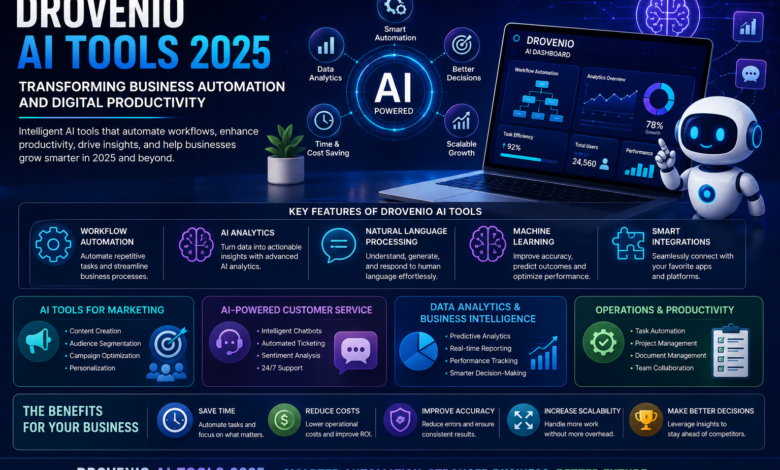
Drovenio AI Tools can be viewed as a collection of intelligent solutions designed to automate workflows, support decision-making, and improve business efficiency through artificial intelligence.
These tools typically focus on helping organizations:
- Automate repetitive tasks
- Analyze business data
- Enhance customer interactions
- Improve workflow management
- Generate actionable insights
- Support digital transformation
The goal is to reduce manual effort while maximizing productivity and operational effectiveness.
Why AI Automation Matters in 2025
Businesses are increasingly under pressure to accomplish more with fewer resources.
AI automation helps organizations by:
Saving Time
Automated systems can perform repetitive tasks significantly faster than manual processes.
Reducing Costs
Businesses can lower operational expenses by minimizing labor-intensive activities.
Improving Accuracy
AI systems reduce human errors and improve consistency.
Increasing Scalability
Organizations can handle larger workloads without proportional increases in staffing.
Supporting Better Decisions
AI analytics provide valuable insights that help leaders make informed choices.
These benefits explain why AI adoption continues growing across industries.
Key Features of Modern AI Tools
Successful AI platforms often include several core capabilities.
Workflow Automation
Workflow automation allows businesses to streamline repetitive processes.
Examples include:
- Data entry
- Report generation
- Customer onboarding
- Document management
- Task assignments
Automation reduces manual workloads and improves efficiency.
Artificial Intelligence Analytics
AI-powered analytics help organizations uncover patterns and trends within large datasets.
Benefits include:
- Predictive forecasting
- Customer insights
- Performance analysis
- Risk identification
Data-driven decision-making has become a competitive advantage for modern businesses.
Natural Language Processing
Natural Language Processing (NLP) enables AI systems to understand and respond to human language.
Applications include:
- Virtual assistants
- AI chatbots
- Automated customer support
- Content generation
NLP technologies continue improving communication between humans and machines.
Machine Learning Capabilities
Machine learning enables systems to improve performance over time.
By analyzing historical data, AI tools can:
- Predict outcomes
- Detect anomalies
- Recommend actions
- Optimize workflows
This adaptive intelligence increases long-term value.
AI Tools for Marketing
Marketing remains one of the most active areas for AI adoption.
Content Creation
AI assists marketers by generating ideas, outlines, and content drafts.
Audience Segmentation
Machine learning helps identify customer groups based on behavior and preferences.
Campaign Optimization
AI analyzes performance data and recommends improvements.
Personalization
Organizations can deliver more relevant content and experiences to customers.
These capabilities improve marketing efficiency while increasing engagement.
AI-Powered Customer Service
Customer expectations continue rising in the digital age.
AI-powered customer support tools help organizations provide faster and more efficient service.
Intelligent Chatbots
Chatbots can answer common questions instantly.
Automated Ticket Management
Support requests can be routed automatically to appropriate teams.
Sentiment Analysis
AI analyzes customer feedback and identifies satisfaction trends.
24/7 Support Availability
Automated systems can operate continuously without interruption.
These improvements contribute to better customer experiences.
Data Analytics and Business Intelligence
Modern organizations generate vast amounts of information daily.
AI tools help convert this data into meaningful insights.
Predictive Analytics
Businesses can forecast trends and anticipate future challenges.
Real-Time Monitoring
AI continuously tracks performance indicators.
Decision Support
Leaders receive recommendations based on data analysis.
Opportunity Identification
AI helps identify growth opportunities and market trends.
Strong analytics capabilities are increasingly essential for business success.
Benefits for Small Businesses
AI is no longer limited to large enterprises.
Small businesses can leverage AI tools to:
- Automate administrative tasks
- Improve customer engagement
- Increase productivity
- Reduce costs
- Scale operations more effectively
Affordable AI solutions have made advanced technology accessible to organizations of all sizes.
Benefits for Enterprises
Larger organizations often use AI to manage complex operations.
Advantages include:
Process Optimization
Automation improves efficiency across departments.
Resource Allocation
AI helps distribute resources more effectively.
Risk Management
Advanced analytics identify potential issues before they escalate.
Strategic Planning
Business leaders gain deeper insights into organizational performance.
Enterprise adoption continues expanding as AI capabilities improve.
Challenges of AI Implementation
While AI offers significant benefits, successful implementation requires careful planning.
Data Quality
Poor data quality can reduce system effectiveness.
Employee Adoption
Teams may require training to work effectively with AI tools.
Security Concerns
Organizations must protect sensitive information.
Integration Requirements
AI solutions often need to connect with existing software systems.
Ongoing Optimization
AI systems require continuous monitoring and improvement.
Addressing these challenges increases the likelihood of successful outcomes.
AI Trends Shaping 2025
Several trends are influencing the future of AI tools.
Generative AI
Generative AI continues transforming content creation, software development, and business productivity.
Hyperautomation
Businesses are automating entire workflows rather than individual tasks.
AI Agents
Autonomous AI agents can perform complex multi-step activities with minimal supervision.
Personalized Experiences
AI enables highly customized customer interactions.
Advanced Predictive Analytics
Forecasting capabilities continue improving through machine learning innovations.
These trends are expected to shape the next phase of digital transformation.
The Future of Drovenio AI Tools
As AI technology evolves, platforms like Drovenio are likely to focus on:
- Greater automation
- Smarter analytics
- Enhanced user experiences
- Improved integration capabilities
- Stronger security features
- More advanced AI models
Organizations adopting AI today position themselves to benefit from future innovations and competitive advantages.
Conclusion
Drovenio AI Tools 2025 reflects the growing importance of artificial intelligence in modern business operations. From workflow automation and customer service to analytics and strategic planning, AI-powered solutions help organizations work more efficiently and make better decisions.
As businesses continue adapting to digital transformation, intelligent automation will play an increasingly important role in driving growth and competitiveness. Organizations that embrace AI strategically can improve productivity, reduce costs, and create stronger customer experiences.
The future of business is becoming increasingly intelligent, automated, and data-driven. Platforms like Drovenio AI Tools are part of this evolution, helping organizations unlock new opportunities and thrive in the rapidly changing digital economy.